
ABOUT
The uncovering of Intragenic Antimicrobial Peptides by Kamal follows a two-step process:
1) Load or create a configuration search file (.conf) generated in configuration menu of Kamal and,
2) Click the Process menu in the Kamal main window and load a .FASTA format file. The fasta file should be annotated using one-letter codes representing amino acids, which are ACDEFGHIKLMNPQRSTVWY and X when it is a gap or unnatural residue. Kamal save files in a semicolon-separated format (.csv) that can be opened by a spreadsheet editor or text file. Once the search is done the results are presented in main window. Loading results can be done in "Results" menu.
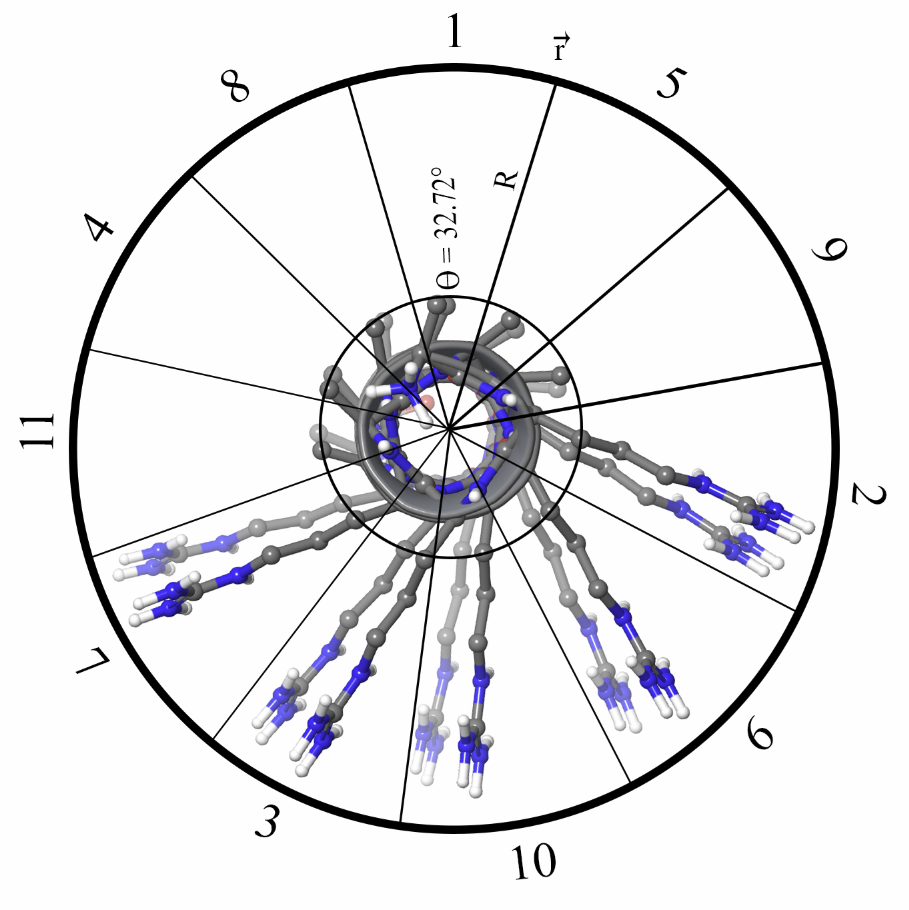
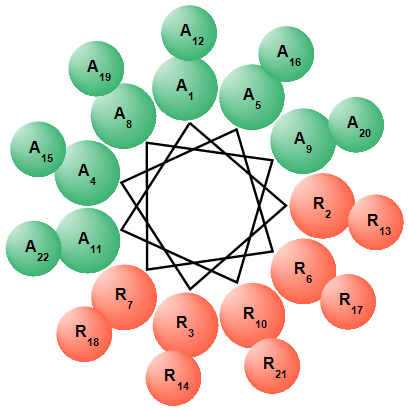
The filtering of α-helical amphiphilic peptides is done following a topological helical wheel model. The hydrophobic face of a theoretical α-helical segment is given by positions 11, 4, 8, 1, 5 and 9 when assuming a polar angle of 160°. The kamal configuration menu automatically sets default amino acid residues for these positions when selecting a desired polar angle. We strongly recommend reading below papers before using Kamal. The resulted search is represented by a 2D image:
PAPERS
Probing Protein Sequences as Sources for Encrypted Antimicrobial Peptides
doi.org/10.1371/journal.pone.0045848.
Starting from the premise that a wealth of potentially biologically active peptides may lurk within proteins, we describe here a methodology to identify putative antimicrobial peptides encrypted in protein sequences. Candidate peptides were identified using a new screening procedure based on physicochemical criteria to reveal matching peptides within protein databases. Fifteen such peptides, along with a range of natural antimicrobial peptides, were examined using DSC and CD to characterize their interaction with phospholipid membranes. Principal component analysis of DSC data shows that the investigated peptides group according to their effects on the main phase transition of phospholipid vesicles, and that these effects correlate both to antimicrobial activity and to the changes in peptide secondary structure. Consequently, we have been able to identify novel antimicrobial peptides from larger proteins not hitherto associated with such activity, mimicking endogenous and/or exogenous microorganism enzymatic processing of parent proteins to smaller bioactive molecules. A biotechnological application for this methodology is explored. Soybean (Glycine max) plants, transformed to include a putative antimicrobial protein fragment encoded in its own genome were tested for tolerance against Phakopsora pachyrhizi, the causative agent of the Asian soybean rust. This procedure may represent an inventive alternative to the transgenic technology, since the genetic material to be used belongs to the host organism and not to exogenous sources.
Encrypted Antimicrobial Peptides from Plant Proteins
doi.org/10.1038/s41598-017-13685-6.
Examples of bioactive peptides derived from internal sequences of proteins are known for decades. The great majority of these findings appear to be fortuitous rather than the result of a deliberate and methodological-based enterprise. In the present work, we describe the identification and the biological activities of novel antimicrobial peptides unveiled as internal fragments of various plant proteins founded on our hypothesis-driven search strategy. All putative encrypted antimicrobial peptides were selected based upon their physicochemical properties that were iteratively selected by an in-house computer program named Kamal. The selected peptides were chemically synthesized and evaluated for their interaction with model membranes. Sixteen of these peptides showed antimicrobial activity against human and/or plant pathogens, some with a wide spectrum of activity presenting similar or superior inhibition efficacy when compared to classical antimicrobial peptides (AMPs). These original and previously unforeseen molecules constitute a broader and undisputable set of evidences produced by our group that illustrate how the intragenic concept is a workable reality and should be carefully explored not only for microbicidal agents but also for many other biological functions.
Towards an experimental classification system for membrane active peptides
doi.org/10.1038/s41598-018-19566-w.
Mature proteins can act as potential sources of encrypted bioactive peptides that, once released from their parent proteins, might interact with diverse biomolecular targets. In recent work we introduced a systematic methodology to uncover encrypted intragenic antimicrobial peptides (IAPs) within large protein sequence libraries. Given that such peptides may interact with membranes in different ways, resulting in distinct observable outcomes, it is desirable to develop a predictive methodology to categorize membrane active peptides and establish a link to their physicochemical properties. Building upon previous work, we explored the interaction of a range of IAPs with model membranes probed by differential scanning calorimetry (DSC) and circular dichroism (CD) techniques. The biophysical data were submitted to multivariate statistical methods and resulting peptide clusters were correlated to peptide structure and to their antimicrobial activity. A re-evaluation of the physicochemical properties of the peptides was conducted based on peptide cluster memberships. Our data indicate that membranolytic peptides produce characteristic thermal transition (DSC) profiles in model vesicles and that this can be used to categorize novel molecules with unknown biological activity. Incremental expansion of the model presented here might result in a unified experimental framework for the prediction of novel classes of membrane active peptides.
Intragenic antimicrobial peptides (IAPs) from human proteins with potent antimicrobial and anti-inflammatory activity
doi.org/10.1371/journal.pone.0220656.
Following the treads of our previous works on the unveiling of bioactive peptides encrypted in plant proteins from diverse species, the present manuscript reports the occurrence of four proof-of-concept intragenic antimicrobial peptides in human proteins, named Hs IAPs. These IAPs were prospected using the software Kamal, synthesized by solid phase chemistry, and had their interactions with model phospholipid vesicles investigated by differential scanning calorimetry and circular dichroism. Their antimicrobial activity against bacteria, yeasts and filamentous fungi was determined, along with their cytotoxicity towards erythrocytes. Our data demonstrates that Hs IAPs are capable to bind model membranes while attaining α-helical structure, and to inhibit the growth of microorganisms at concentrations as low as 1μM. Hs02, a novel sixteen residue long internal peptide (KWAVRIIRKFIKGFIS-NH2) derived from the unconventional myosin 1h protein, was further investigated in its capacity to inhibit lipopolysaccharide-induced release of TNF-α in murine macrophages. Hs02 presented potent anti-inflammatory activity, inhibiting the release of TNF-α in LPS-primed cells at the lowest assayed concentration, 0.1 μM. A three-dimensional solution structure of Hs02 bound to DPC micelles was determined by Nuclear Magnetic Resonance. Our work exemplifies how the human genome can be mined for molecules with biotechnological potential in human health and demonstrates that IAPs are actual alternatives to antimicrobial peptides as pharmaceutical agents or in their many other putative applications.